
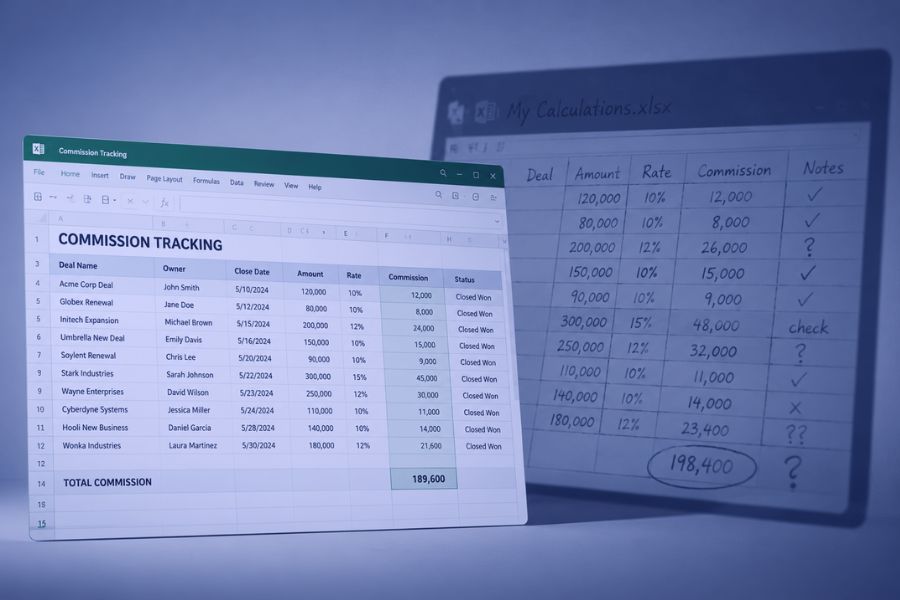
Shadow accounting happens when sales reps keep their own commission records outside the official system. They track deals, payout estimates, accelerators, exceptions, and expected earnings in personal spreadsheets because they do not fully trust what they will be paid.
For many companies, this looks like a sales behaviour problem. In reality, it is usually a transparency problem.
When reps cannot clearly see how their commission is calculated, they create their own version of the truth. That version may be incomplete or based on assumptions, but it gives them a sense of control.
Why Shadow Accounting Starts
Sales teams usually start shadow accounting when the official payout process feels unclear, delayed, or unpredictable.
The most common causes include:
- Unclear commission rules
- Delayed payout visibility
- Frequent manual adjustments
- Disputes over deal crediting
- Lack of access to real-time earnings data
- Low confidence in spreadsheet-based calculations
These issues create friction because commission is personal. It affects income, motivation, and trust in the company. When a seller has to wait until the end of the month or quarter to understand what they earned, uncertainty builds quickly.
This is especially common when incentive plans include thresholds, accelerators, product-specific rates, split credits, or manual exceptions. The more complex the plan becomes, the harder it is for sellers to validate their expected payout without better visibility.
The Hidden Cost of Shadow Accounting
Shadow accounting does not only affect sales reps. It creates hidden work across sales management, finance, HR, and revenue operations.
A rep may spend hours checking numbers instead of selling. A manager may need to explain calculations repeatedly. Finance may receive more payout questions, dispute requests, and manual checks.
Over time, this creates a broader trust issue. If sellers believe the commission process is unreliable, they may question not only the payout, but also the fairness of the incentive plan itself.
This is why stronger commission transparency matters. It reduces the need for personal tracking because sellers can see how their earnings are calculated and where each number comes from.
How to Reduce Shadow Accounting
The goal is not to stop reps from caring about their earnings. The goal is to give them a system they can trust more than their personal spreadsheet.
Companies can reduce shadow accounting by improving a few key areas:
- Make commission rules easier to understand
- Give reps visibility before payout day
- Show deal-level payout calculations
- Create a clear process for disputes and corrections
- Reduce manual adjustments where possible
- Use consistent crediting rules across teams and roles
A proper sales incentives audit can help identify where confusion starts. Sometimes the problem is the plan design. Sometimes it is poor data quality. Sometimes it is the manual process used to calculate payouts.
The important point is that shadow accounting is a symptom. It usually shows that the official process is not giving people enough confidence.
Where ICM Helps
An Incentive Compensation Management tool helps reduce shadow accounting by connecting plan rules, sales data, calculations, approvals, and reporting in one controlled environment.
Instead of relying on personal spreadsheets, reps can see what they are earning, why they are earning it, and how each payout was calculated. Sales leaders and finance teams also get a more consistent view of incentive performance.
This becomes especially important as companies grow. More roles, products, regions, channels, and exceptions make commission management harder to control manually. Better incentive compensation management software helps keep that complexity visible and governed.


Final Thoughts
Shadow accounting is not just a sales team habit. It is a signal that reps need more clarity, faster visibility, and greater confidence in the commission process.
When salespeople trust the system, they spend less time checking numbers and more time focusing on the behaviours the incentive plan was designed to encourage.
For companies that want fewer disputes, better motivation, and stronger payout governance, reducing shadow accounting is a practical place to start.