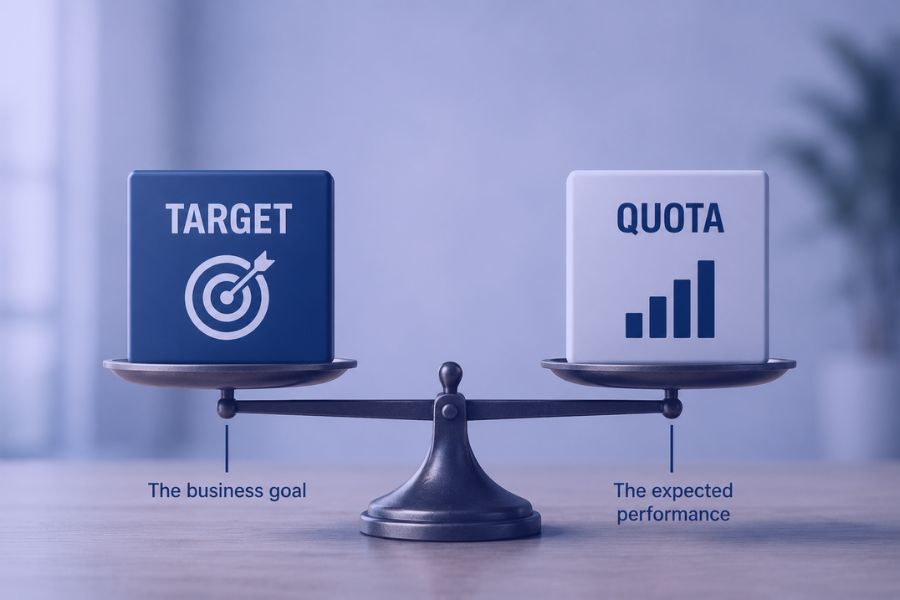

Sales incentives are easy to approve when revenue is growing. They are harder to defend when budgets tighten and leadership asks a simple question: “What did we actually get for this spend?”
That is where measurement matters. The strongest incentive programs are designed with evaluation in mind, so you can prove value, improve the structure over time, and avoid paying for outcomes that would have happened anyway.
Below is a practical way to measure incentive value using ROI and ROO, plus the operational steps that make measurement credible.
ROI vs ROO: two measures that answer different questions
Return on Investment (ROI)
ROI measures financial return relative to total program cost. A common approach is:
ROI = (Incremental margin generated – incentive cost) ÷ incentive cost.
Another useful view: treat program cost as a percentage of incremental sales, often used for budgeting and governance.
Return on Objective (ROO)
ROO measures success against a defined objective, including outcomes that are not purely financial. For example: increasing market share, improving customer satisfaction, increasing product mix, or growing partner deal registrations.
ROO is usually expressed as achievement versus target, like “120% of objective achieved.”
A useful rule: use ROI to evaluate financial return, and use ROO to evaluate whether the incentive produced the behavior change you wanted.
How to calculate ROI in a way finance will accept
Step 1: Define “incremental”
ROI breaks down when “incremental” is vague. The goal is to estimate what changed because of the program.
Incremental sales = Total sales – Base sales, where base sales are what would have occurred regardless of the program.
Step 2: Use margin, not just revenue
Incentives are paid from profit, not from topline pride. Many teams calculate ROI using incremental gross margin (or contribution margin) rather than revenue.
Step 3: Include full program cost
Total cost should include incentive payouts plus operational cost (admin time, systems, fulfillment, communications, and any fixed fees).
A simple example
- Incentive cost: £100,000
- Incremental gross margin generated: £400,000
- Net margin gain: £300,000
- ROI = £300,000 ÷ £100,000 = 3:1 ROI
How to calculate ROO (and why it prevents “wrong wins”)
ROO starts with a measurable objective and an agreed definition of success.
Examples:
- Acquire 50 net-new customers in a quarter
- Increase attach rate of a strategic add-on to 30%
- Improve partner deal registration by 25%
- Reduce churn in a target segment by 10%
Then measure the outcome versus objective. If the goal was 50 and the result was 60, ROO is 120%.
ROO is especially useful when:
- you are launching a new product and adoption matters before profit peaks
- you want to shift selling behavior, not simply lift volume
- you have quality goals (retention, customer outcomes, compliance) that protect long-term value
If you want to broaden beyond pure revenue measures, Motiwai’s guidance on qualitative measures in sales incentives shows how teams structure scorecards without losing clarity.
Proving incrementality without overcomplicating it
You do not need a statistics lab to improve confidence. You need better comparisons.
Practical options:
- Baseline comparisons: compare against the same period last year, adjusted for major changes (pricing, territory, product availability).
- Test vs control: run the incentive for one segment and compare with a similar segment that is not eligible.
- Before vs after with guardrails: if you cannot do a control group, document assumptions and track confounders.
We call out lift analysis as a core technique for isolating incremental sales versus “business as usual.”
The operational reality: measurement fails when execution is weak
Even a great measurement plan collapses when the program is hard to calculate or the data is unreliable.
Common failure points:
- inconsistent source data across CRM, finance, and order systems
- unclear eligibility rules and exception handling
- late payouts that distort performance timing
- limited audit trail, leading to disputes and loss of trust
This is where many organizations move beyond spreadsheets and use Incentive Compensation Management (ICM) software to standardize rules, validate inputs, and create transparent statements that both sales and finance can rely on.
If incentive disputes are eating time and credibility, see how automation reduces commission disputes for common causes and what operational fixes look like in practice.
A short checklist: design incentives that are measurable from day one
Before launch, confirm you have:
- A clear objective (ROO) and a financial hypothesis (ROI)
- A baseline definition and a plan for incrementality
- KPIs and data sources that are validated
- Rules that are simple enough to explain and strict enough to govern
- A reporting cadence (weekly pacing, monthly close, quarterly evaluation)
- An exception and dispute process that does not rely on ad hoc approvals
Closing
When you measure incentives with ROI and ROO, you shift the conversation from “incentives as spend” to “incentives as a managed growth lever.” You also gain the ability to improve programs each cycle, based on evidence rather than opinion.If you want help setting up incentive measurement that finance trusts and sales can follow, contact us to see how Motiwai supports accurate calculation, transparent reporting, and governance across complex incentive programs.